Latest News

The latest article by “The Centurion” is now available to read here:
The Lost Diary
The second instalment of thrilling stories by “The Centurion” is now available to read here:
They Fight like Devils
The First in a new series of articles about the exploits of The Durham Light Infantry and its predecessors written by DLI Friend “The Centurion”.
Righting the Wrong – Bugle Major John Gibbons
1915 DLI Trench Diary - Cpt. William Regis Claude Hutchinson 2nd Bn
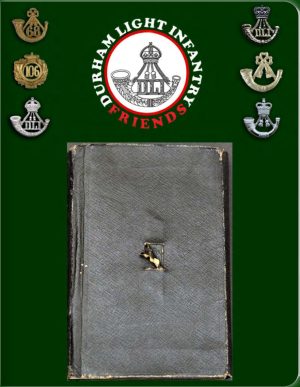
Sid Patterson from The DLI Friends won the above Diary in a recent auction and we have presented it to “The Story” where it will now become part of the DLI Collection.
You can read it online here as a flipbook or download it as a full transcript.
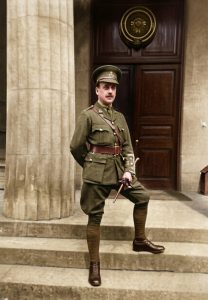
William Regis Claude Hutchinson was born in 1875, son of Cecil William and Clara Henrietta Hutchinson of Eggleston Hall, Darlington.
He entered directly as a Captain in the 3rd Battalion D.L.I. on 29 April 1907 and was a Captain of the 4th Battalion in 1908.
With the 2nd Battalion D.L.I. he entered the France/Flanders theatre of war on 27 November 1914 but was invalided on 18 May 1915 due to gas poisoning.
He was then employed on the Intelligence Staff of Tyne Garrison, attached General Staff from 24 February 1916 and Staff G.H.Q. Home Forces from 1 March 1917. He was placed on the Retired List on 16 October 1919 due to ill-health caused by the gas.
He was specially commended in August 1918 for his work with refugees from North Russia arriving at the Tyne Garrison.
An entry in the diary for June 15th 1915 reads: Tuesday 15 (166-199) Eggleston. Went for long walk up the Burn with Ethel + Rosamund. Air Raid near Jarrow. We heard the firing at midnight.
This is the Zeppelin raid on Newcastle & Palmers Shipyard, Jarrow (34 Miles away) that is documented in the recently purchased enlistment register, it can be viewed here: https://dlifriends.com/ledger-2
World War 1 Volunteers Ledger
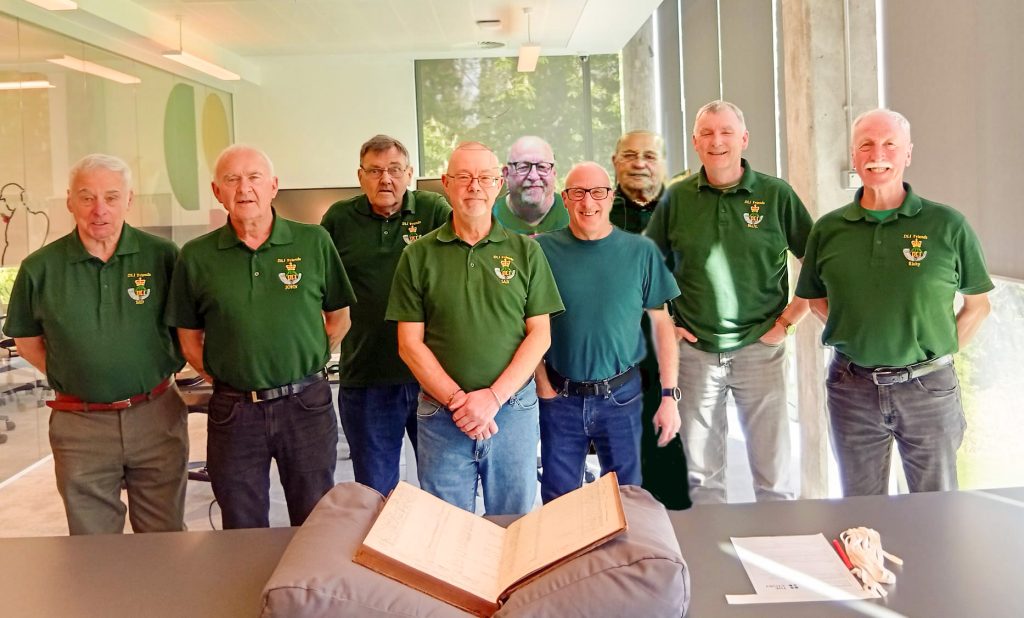
The Ledger has now been handed over to the DLI Collection at The Story, view the history behind it and a fully text searchable version of it here Ledger
A rare handwritten ledger listing hundreds of County Durham men who volunteered for the First World War after a deadly Zeppelin raid— many determined to avenge their fallen workmates — has been purchased at Auction by the DLI Friends.
Bought for just £20 at a car boot sale, the century-old register records about 900 volunteers who signed up over just three days in December 1915.
Most were workers from Palmers Shipbuilding and Iron Company in Jarrow, one of the great industrial names of the Tyne. Of those who enlisted, nearly one in six would lose their lives in the conflict.
Read the online article from The Northern Echo here:
https://www.thenorthernecho.co.uk/news/26064679.dli-ledger-listing-900-men-palmers-shipyard-given-story/?ref=rss
Their decision to join up came in the shadow of tragedy. Just six months earlier, the Palmers yard had been devastated by a German Zeppelin raid, which killed 17 and injured 72.
The attack struck at the heart of the Tyneside shipbuilding community, where thousands of men and boys built Britain’s wartime fleet. Palmers alone employed about 10,000 workers and was central to County Durham’s heavy industrial identity.
Due to a communication failure that night, blackout orders were never passed on to the yard, leaving it brightly lit and an easy target for the raiders.
In the aftermath, hundreds of men queued to sign an “attestation” register — pledging to serve, despite shipyard workers being classed as a reserved occupation.
Militaria expert Matt Crowson, of Hansons Auctioneers, said the ledger is both rare and deeply significant.
“There’s no doubt the raid would have brought home the seriousness of the war to the brave Jarrow workers, many of whom would have wanted retribution,” he said.
“Books like this are extremely rare, as records were supposed to have been destroyed after the war. How it came to light hundreds of miles away, we may never know.”
Each of the 23 double-page entries is a snapshot of a time and place — recording the men’s names, ages, height, chest measurements and distinguishing marks.
Among them are timekeeper Theodore Stewart, plumber James McAtominey and blast furnace workers Anthony Coffey and James McGuckin. Many later served with the Durham Light Infantry or Royal Navy.
The volunteers enlisted under the Derby Scheme — a final nationwide push for recruits before conscription was introduced in 1916.
Men aged 18 to 40 could “attest” their willingness to serve and were allowed to return to their jobs until called up, receiving a grey armband and a modest bonus of 2s 9d.
The ledger’s current owner, a builder’s merchant from Maldon in Essex, said he discovered it lying on the ground at a car boot sale.
“When I saw the word ‘military’ on the cover, I knew it was something special,” he said.
“I just want these names and their sacrifice to be known. It’s the least they deserve.”
Northern Echo Article
An Article written by Major Donald McDonald about his times at Brancepeth Camp.

Brancepeth 1954
As I write this it is 60 years to the day that I joined the DLI as a recruit in those days all candidates for Regular Commission had to undergo basic recruit training before going to Sandhurst.
I got on the train at Darlington, together with several other apprehensive recruits to travel the short distance on the branch line to Brancepeth Station. There we were herded onto 3 ton lorries and driven to Brancepeth Camp.
I remember a long wait in the NAAFI while we were processed and documented. Looking out of the window we would see other squads speeding across the square undergoing what seemed like immaculate drill. A visit to the Q M’s stores followed where we were overloaded with a mountain of kit, and thence to hut 45.
Hut 45 was a standard army wartime hut with rows of beds down either side, a length of red lino highly polished with cardinal polish and a coke store and fuel bin. I found myself with a Bishop’s son on one side of me and a lad who had been recently released from Durham Jail on the other.
All except me were National Servicemen and when it became known I was a potential officer I became the butt of many practical jokes and hilarity such as my wearing pyjamas in bed. I learnt more about soldiers and soldiering in those first few weeks than ever did there after.
It is perhaps unfortunate that potential officers no longer this baptism of fire. I remember our first meal to this day. Because of the lengthy arrival process we got to the cookhouse very late for tea. Slammed down on our plates were two cold, burnt sardines on toast accompanied by bread, and a soldiers pint pot of cold sweet tea.
Whether it contained the apocryphal bromide we never discovered and were too busy to find out. I spent the first weekend sewing on regimental buttons on to a greatcoat. In good Q M’s fashion we had been issued with great coats without buttons but with the requisite number in the pockets. I had been taught to sew as a small boy, as part of the wartime make-do and mend regime, whereas most of the geordies did not have a clue how to thread a needle let alone sew on a button straight.
It was a rather a painful weekend, as both arms were sore from the dreaded TABT injections and my fingers were red raw from the very tough great coat material.
Beside each bed was a small mat underneath this was a knothole featured in a later episode of my Regimental life. After Christmas an New Year leave I was sent to Strensall to the Light Infantry Depot “Leader platoon”. Thus my first experience of Brancepeth Camp came to an end.
Brancepeth 1956
I passed through Brancepeth in August 1956 having been Commissioned into the DLI in July that year. We were indoctrinated into the ways of the Regiment by Topper Brown, and Harry Lowe, enshrined in his lair above the photograph shop on Elvet Bridge. He enrolled me into the DLI Association with a badge which I still have, and the Friends of Durham Cathedral which I still am.
We were sent down the Pit at Willington and made to crawl through one of the lowest coal faces, a very salutary experience! While waiting to join the 1st Bn, which was deployed at running ACF Corps at Catterick, I was attached to the training endless intakes of National Servicemen.
Most of the routine work was done by the NCO’s, one of the training subalterns was a certain ‘Mr Smith’ who was preparing to undergo SAS selection and training. On the days when we were shooting at Whitburn Ranges. Some 23 miles from Brancepeth, he would set off at 6am in full marching order and carrying a bren gun and ammunition.
His route took him through the middle of Sunderland. One wonders what a stir that would cause today! I also recall being invited by him to use chunks of P4 explosive in lieu of thunderflashes when training at Battlehill. I seem to remember he marched there as well.
As Orderly Officer one mounted the night guard and selected the smartest member to be the guard at the gatehouse entrance to the castle. This was thought to be a cushy number as his main duty was to open and close the gate for visitors or residents of the castle.
There was a cupboard in the castle guard room with a notice ‘please do not open’ of course the unsuspecting recruit soldier could not resist the temptation to open the door where he was faced with a large stuffed bear. The Orderly Officer only had to wait for a minute or so after leaving the guard room for there to be a scream and an ashen faced recruit erupting from the guardroom.
The Training Company Commander while I was there was Major Jim Collingwood. He handed over to Major Norman Benson who had a highly polished entrenching shovel on the wall above his desk. This had a sharped edge with which he was reputed to have cut off the head of an opponent. Needless to say no one argued with him.
Later that year I was posted to the 1st Battalion at Humbleton Camp, Barnard Castle. I much enjoyed the smart salute on arrival from the duty Provo Corporal, who had seen me off from the Guard Room at Brancepeth when I left there as a recruit with words to the effect that ‘if you ever think I am going to salute you as an officer you can think again’ Well he just had!
Brancepeth 1961
I returned to the Depot for the last time in 1961 to be Adjutant under Leslie Fleming who had been my Company Commander in B Company 1 DLI. It was a sad time in many ways as the Depot was under notice to close in April 1962.
The recruits gradually moved to Pontefract as the new Light Infantry Depot at Shrewsbury was not yet ready. It was also quite relaxed as I managed to continue being Adjutant with playing Polo at Catterick in the summer and hunting with the Tees Valley Beagles in the winter.
Much of our time was spent disposing of the contents of the castle after over 20 years of occupation, with numerous cellars and many office’s nothing had ever been thrown away. For instance these were over 200 soldiers boxes containing the effects of soldiers killed in the Second World War stored in the cellars. These had never been claimed by the next of kin.
None of them had been returned to the NOK. Most contained spare items of clothing and military uniform. Each had to be opened and the contents listed before being disposed of mostly by burning.
We had a bonfire burning continuously for weeks, as duplicate files and unwanted bumph were unearthed from cupboards and attic. Yes we did check everything very carefully to ensure that worthy of any value or interest was destroyed!
All this time our new RHQ at Elvet Waterside was being built, as a joint project between the War Office and TAVRA. One morning Leslie Fleming and I went down to the building site and a time capsule was buried in the foundations of the new building stone under the course nearest the river and the swimming baths.
The War Office allowance for a new Regimental Museum was the large room upstairs in RHQ now used by Chris Lawton. This was clearly totally inadequate so detailed negotiation took place with Durham County Council to allow them to rehouse the museum.
At the meeting which the proposal was to be formally agreed a number of proposals were put forward as to the amount of money to be spent on the project. The chairman effectively ended the discussion by proposing that the Museum should be built and they would worry about the amount afterwards. This was carried unanimously.
We held a large party to say goodbye to old Regimental friends and civic dignitaries. One number of the “chain gang” obviously enjoyed the party and was very loth to leave. She finished up, propped up against the sideboard, surrounded by a circle of Regimental lots wondering what to do.
Suddenly, at the far end of the long room her chauffer and mace bearer appeared, heralded in step down the room halted and bowed to her. Turning about they looked up under each elbow and marched her ceremoniously out to her car. This was obviously a well rehearsed procedure.
I left the Depot before it actually closed to go out to Singapore to be ADC to Sir Nigel Peott. It was an interesting accident of listing that my grandmother, Mrs Roberts of Bedburn Hall as a serving ATS Officer arrived at Brancepeth Castle a day to help get it ready for occupation, and I was there almost on the last day of our occupation, and the happy arrangement which lasts to this day was set up.
There were some happier discoveries in the cellars, including 2 very smart Tientsin rugs, which must have been sent over by the 2nd Bn at the start of the Second World War, and forgotten about. These are now to be seen in the Rifles Office. Also a case of 1 doz half bottles of champagne were found hidden under a pile of old boxes in the cellars. These had obviously been hidden by some miscreant at a past Regimental function but were never disposed of.
The Adjutant decided that it was far too complicated to hold a detailed inquiry into the matter and drink the evidence himself. The Castle contained a very fine collection of big game hunting trophies. These had been presented in 1939 to furnish what was an enormous empty building. Some were given to the Hancock Museum in Newcastle, who were given first refusal, others were sold including an enormous Rhinoceros head and horn, which was sold for I think £25.00 it would be worth very much more today, although not able to be sold legally.
Transcript by John Rolfe.
Catania Cemetery, Sicily.
Footage of Catania cemetery, Sicily courtesy of:
S/Sgt
John Heron
(23 SAS retd)
click on the link below
Replacement DLI Pals Information Board
Members of the DLI Friends & DLI Association assisting with the replacement of the faded DLI Pals information board next to the River & bandstand at Durham Racecourse.


Donald McDonald – a proud Durham Light Infantryman!

I first met Donald in 2003 at the Rifles Office, Durham (then, called the Light Infantry Office).
Major Donald McDonald was chairing an editorial team of ex-soldiers who were putting together a magazine called The Durham Bugle on behalf of The DLI Friends – a charity supporting the DLI Regimental Collection. The Durham Bugle was three years old – a new millennium production. I learned that Donald was the Editor, also the producer and that he had a big smile.Kevin Storey, the Secretary of the Durham Light Infantry Association was one of the team and that’s how I came to be there. We were both members of the Dunelm Club in the City.
Kevin believed I should join the team as I had been writing articles for some time for Picture Postcard, a national magazine.
Donald and the others made me very welcome – something I hadn’t really expected as I, initially, felt more like an intruder. I was certainly out of my depth regarding DLI history, never having been a regular soldier or a National Serviceman, and I saw my role as limited to that of helping to improve and develop the look of the magazine. I was happy to leave the content to those with the knowledge!
Donald set out to educate me, though, regarding DLI history, ably assisted by the rest of the editorial group. Before long, I was writing bits and pieces for the magazine. As part of his educational policy for me Donald insisted I went with him to the printer’s premises so that I could meet those individuals in the background who helped make the magazine a reality. This was to stand me in good stead eventually as, when Donald suffered a heart attack years later, I was able to step in and get the magazine finished, printed and distributed.
From the beginning, and particularly during his recovery, Donald was happy to pass on to me as much information as he could and it was an enormous help. His knowledge of the history of the regiment was invaluable, and he had made so many contacts during his military career, and post-service, that we were never short of content. We had an abundance, and Donald liked nothing more than the opportunity to relate a few of his regimental stories.
As the magazine design became more ambitious Donald was happy to leave the layout and production up to me and focus on the wonderful stories that went to print. He was a larger than life character, with a great pride in his regiment and its history and he took huge pleasure in being able to give something back by continuing the DLI tradition of publishing regimental magazines
I’m proud and grateful that I had Donald as a friend – only sad that his final years, fighting physical and mental illness, were difficult.
Donald died on Sunday 25th May 2025.
Farewell friend! You will not be forgotten! Rest in Peace!
Peter Nelson
Chairman DLI Friends
DLI Friends Battlefield Tour Holland & Belgium.
Between 4th and 9th May three members of the Bishop Auckland Branch of the DLI Association ( DLI Friends) John Rolfe, Ian Brown and Paul Errington travelled to Holland and Belgium for a Battlefield Tour centred on the DLI and their Battles of 1940 and 1944 during WW2.
Initially staying in Arnhem to cover some of the sites of the 1st Airborne Divisions Heroic defensive stand a visit was made to the area around Bemmel and Haalderen in the Betuwe the area between Arnhem and Nijmegen known as “ The Island “ where 6 , 8 and 9 DLI fought to hold Frontline against counter attacks by German Panzer units in early October 1944 suffering heavy casualties in the process many of which are buried in the Oosterbeek Cemetery in Arnhem together with many of the Polar Bears of 49th West Riding Infantry Division who alongside the Canadians liberated Arnhem during the second and almost unknown Battle for the City , Operation Anger / Quick Anger which took place in April 1945.
After leaving the Arnhem area a drive of 2 ½ hours via a stop at Valkensvard CWCG Cemetery which is on the famous “ Club Route “ of Operation Market Garden took us to Gastuche / La Tombe on the River Dyle where Dickie Annand d Coy 2 DLI won the Regiments and the British Armies first Victoria Cross of World War 2. The area which remains almost unchanged from May 1940 was walked to gain a lie of the land and the Battlefield of fields, heavily wooded slopes and of course the river and the bridge across it where Dickies famous action took place. A DLI Wreath was laid at the Memorial to all those lads from 2 DLI who were killed in action attempting to hold up the German advance towards Brussels.
Leaving the Dyle area, we headed to Geel for two days to look at one of the Regiments last major Battles in North west Europe where after 8 DLI forced a crossing over the Albert Canal both the 6th and 9th DLI followed them over to establish a bridgehead and capture the city of Geel. 6 DLI together with tanks of the Sherwood Rangers forced there way into the city but all three Bn’s were counter attacked by German Parachute units, Tanks and Jagdpanthers. Heavy fighting took place which led to substantial losses over the course of the Battle but the vital Bridgehead was held and eventually the Germans withdrew and 151 ( Durham Brigade ) went into reserve.
Visits were made to Battlefield locations and the Cemetery at Geel (Stelen) situated at the Church literally 100 years from where 8 DLI crossed the canal where a wreath was laid at the 50th Infantry Division memorial and then the main cemetery in Geel itself in each location sadly many young men of the Regiment found their last resting place.
The following day the 8th May, VE Day 80th Anniversary we were invited as guests of honour at a service arranged by the local community at Leopoldsburg CWCG Cemetery where Again many lads of the DLI now lie and are remembered. As part of the service John Rolfe laid a DLI Wreath at the Cross of Sacrifice and during what was a wonderful service attended by Belgian Military, local people and children the local Choir sang a number of songs one of which incredibly as it was sung during the wreath laying was the Regimental hymn Abide with Me . The Choir master and the members were thrilled to find out that their choice of Hymn chosen without knowledge of its significance was so poignant and meaningful to the DLI members present.
An excellent few days travelling to some of the areas of DLI Battles that are not often visited as part of the DLI Friends ongoing research into the History of the Regiment.


VE Day 80th Anniversary Bugler at The Story
The Fighting Bradfords


The medals awarded to Colonel Sir Thomas Bradford – the eldest of four North East brothers who all fought with valour in the First World War – are now back in his home county, thanks to the vigilance of The DLI Friends member Sid Patterson.
Sid is a keen collector of medals and has a vast knowledge of the Durham Light Infantry. He recently spotted the medals for sale on a London Auction site (they have been sold several times over the years) and it was flagged up to the Trustees of the Regimental and Chattels Charity of The Former Durham Light Infantry.
The Trustees bought the medals at the auction and have presented them to Durham County Councils culture and heritage venue, The Story, for safe keeping.
The Story is home to the DLI Collection and Archive, and the acquisition means the medals have been united with other gallantry awards, objects and archives relating to the Bradford brothers. This includes the Victoria Cross presented to Brigadier General Roland Boys Bradford VC and the Death Penny of Second Lieutenant James Barker Bradford MC, both of which are on display in The Story’s free exhibition space.
These items are a record of the Bradford brothers’ heroic actions during the First World War, but they are also a poignant reminder of a family’s tragic loss. Thomas was the only brother to survive the conflict. Both Roland and James, who also served in the DLI, and their other brother, Lieutenant Commander George Nicholson Bradford VC, who served in the Royal Navy, were killed in action.
Raised in Witton Park, near Bishop Auckland, the ‘Fighting Bradfords’ are believed to be the most decorated family of the First World War, with two Victoria Crosses, one Distinguished Service Order, two Military Crosses and three Mentions in Despatches between them.
All items relating to the Bradford brothers under The Story’s care are available to view in the venue’s Collections Search room by appointment.
Well spotted Sid!

The Durham Light Infantry Friends are volunteering at The Story on the last Thursday of every month.
Why not drop in this Thursday 29th May, between 10:00-14:00 and have a chat with this extremely knowledgeable, passionate and friendly group. The DLI Friends is a charity run for, and by people who support and work with the DLI Collection.
Please note we can only assist with research about the DLI as we don’t have Full access to other Regiments records.
The Auckland Project
Thanks to a link between members of the DLI Friends & The Auckland Project we have managed to secure a substantial amount of hardwood for The Veterans Community & Enterprise Centre Wood Turning Group at Newton Aycliffe.


We now have a list, complete with links, of historic footage of the DLI that’s located at various sources online.
Either use the information drop down in the menu bar and select DLI online video or follow this link:
DLI online video
Sid Patterson from The DLI Friends recently discovered and successfully bid, on behalf of the DLI Friends for the document below.
The document is signed by Lieutenant Malby Brabazon on 26th February 1777 in Strabane, Ireland for the supply of 10 men for the use of his Majestys 68th Regiment of Foot.

The Receipt was accepted into the DLI Collection on 6th February 2025 where it joined other early 68th Regiment documents which include:-
A copy of a list of officers of the 68th Regiment of Foot, Jersey, Channel Islands, 1755 – 1758
A statement of the parade state of the 68th Regiment of Foot, commanded by Colonel John Lambton, as it embarked at Cowes, Isle of Wight, 23 July 1758 and Several officer commissions for 1760.
The Morant sword
Three generations of the Morant family had served in the 68th Regiment and the succeeding Durham Light Infantry Regiment, so there was much of DLI interest. HHS Morant had, among other army appointments, commanded the 10th Battalion DLI in WW1. Though many items were purchased for the DLI Collection not all were won. HHS Morant’s sword, for example, went at that time to a sword collector in the USA.
On the 31st October 2024 the DLI Friends group met to present the DLI Collection with that sword. It had appeared again and Sid Patterson of the DLI Friends purchased it at auction on behalf of the group. In doing so the DLI Friends were fulfilling the original purpose for which the group was founded – to acquire items for the DLI Collection.
See pictures of the sword & further details here
Catania Cemetery, Sicily.
Footage of Catania cemetery, Sicily courtesy of:
S/Sgt
John Heron
(23 SAS retd)
click on the link below
22nd January 2024
In June 2023 I was approached by Sid Patterson and asked if I could digitally add a medal and other items to an image of an oil painting of Maj. Reed.
Sid had in his possession some of the items he wanted adding.
I created the new image and Sid was delighted, however the story didn’t end there. Sid had always wanted the image to be created as an oil painting so after searching the internet he came across artist Chris Pickstock.

Chris records a timelapse of his paintings, this can be viewed on his youtube site here Major John Reed
You can also visit his facebook page here. Facebook
I’m sure you’ll agree he did a wonderful job.
Graeme Bowser
International Online Shop
Our online shop is now operating around the world with orders shipped just before Christmas to both Canada & Australia.
Here is Jim wearing his DLI Polo Shirt at the RAAF Museum, Bullsbrook, Perth, Western Australia.

17th March
Hear DLI Friends John Rolfe & Ian Brown being interviewed about the Bishop Auckland Town Hall medal display on Bishop FM


